
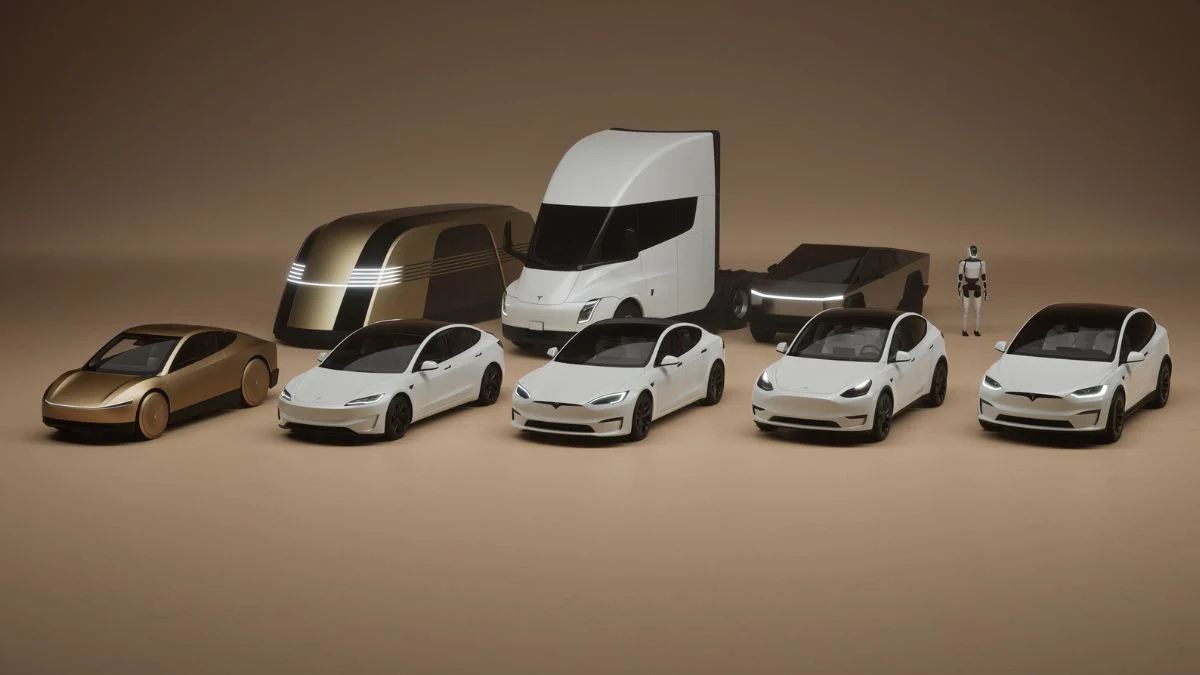


The Tesla rage is real.
Few companies ignite as much controversy — or confusion — as Tesla. Some still call it just a car company. Others can’t get past Elon Musk’s antics. And many analysts remain skeptical about Tesla’s ability to solve Full Self-Driving let alone humanoid robots, because it doesn’t fit neatly into their five-year financial models.
But if you’re looking for the next 10x opportunity, you need to look beyond the surface.
1. Waymo vs. Tesla: Symbolic AI vs. Real-World Neural Network
One major misconception is that Waymo is ahead in the race toward Full Self-Driving. After all, Waymo vehicles already operate robotaxi services in limited U.S. cities. But Waymo and Tesla are pursuing fundamentally different approaches to autonomy.
Waymo uses symbolic AI — also known as rules-based or classical AI. It relies on pre-programmed logic, high-definition maps, and painstakingly labeled datasets. Its system uses an expensive sensor suite, including LiDAR, radar, and cameras. LiDAR provides detailed 3D mapping but is costly and hard to scale for mass-market deployment.
Each new city requires extensive manual work: mapping every road, encoding local traffic rules, and running validations. The result is a system that performs well in controlled zones, but scales slowly and expensively.
Tesla uses a neural network-based AI approach, or what Andrej Karpathy calls Software 2.0. Instead of coding rules, Tesla trains its networks on billions of miles of real-world driving footage. Its camera-only system mimics human vision, teaching the network to perceive and act accordingly.
When Tesla entered China, it didn’t need to reprogram anything. The system trained on online dashcam footage to recognize local signs and driving behavior. Such self-supervised, scalable learning gives Tesla a significant edge.
While Waymo expands city by city, Tesla is building a system that can generalize globally. It learns like a human — by watching, adapting, and improving. Tesla’s early bet on neural networks and vision is paying off with a platform that improves over time and crosses borders.
So yes, Waymo’s path may look safer. But it’s brittle and slow. Tesla’s is harder at first — but ultimately far more scalable and built for the real world.
2. Valuing Tesla as a Car Company Misses the Point
Wall Street often values Tesla like it’s a car company with a tech twist. But that’s like valuing Apple purely as a phone company. Yes, the iPhone was transformative, but Apple’s true power lies in the ecosystem it built — software, services, the App Store, and recurring revenue. Investors who focused only on hardware missed the exponential upside.
The same mistake may be happening with Tesla.
Traditional analysts rely on five-year discounted cash flow (DCF) models built for predictable, linear growth. Anything beyond that — especially innovation without near-term revenue — is often treated as too abstract to price or simply outside the bounds of traditional valuation models. But I believe that Tesla’s most valuable bets extend far beyond the next five years.
Take Full Self-Driving (FSD), Optimus, or Tesla’s AI infrastructure. These could take time to scale, but each unlocks an entirely new business model — from robotaxis to automated labor. Yet most analysts leave them out of their models because they can’t easily quantify them.
We’ve seen this before. In the iPhone’s early days, Apple was still treated like a hardware company. Wall Street missed the network effects and the growing software ecosystem — and by the time the revenue showed up, the upside had already shrunk.
Tesla isn’t just a car company. It’s developing:
- Real-world AI for self-driving,
- A scalable energy business with Megapacks,
- And a robotics division (Optimus) that could one day disrupt labor.
Each of these is a distinct S-curve — rarely captured in traditional valuations.
By the time the market fully realizes their value, the stock may already be much higher. That’s why investors seeking long-term asymmetric returns must look beyond spreadsheets — and get in before the world catches up.
3. Elon Musk Isn’t Perfect — But He Builds Like No One Else
It’s easy to dismiss Elon Musk because of his tweets, antics, or public persona. But leadership — especially at this scale — isn’t about perfection. It’s about execution.
Elon has built a culture in all his companies that attracts top engineers, moves at breakneck speed, and tackles problems others avoid. As NVIDIA CEO Jensen Huang pointed out, Elon scaled its AI data center in just 19 days — something that would take most companies nearly a year. That’s not luck. That’s execution.
Yes, Elon has made controversial remarks. He’s smoked weed on Joe Rogan’s podcast, joked about Dogecoin, and made erratic political comments. Those moments sparked media backlash and short-term stock swings. But investing isn’t about reacting to headlines — it’s about seeing past them.
Every leader has flaws. What matters is whether the company stays laser-focused on its mission, maintains world-class execution, and drives relentless innovation. Elon has done exactly that. He runs lean, recruits elite talent, and operates from first principles.
Many gave up their shares during those moments. But years of reading up on company’s leadership and business gave me the conviction to hold and see past these noises. As long as Tesla keeps building with purpose and pace, I’m staying invested.
Because at the end of the day, I’m not investing in a tweet — I’m investing in a company creating sustainable abundance.
4. Investing in a Great Company Isn’t Easy
There’s a common belief that investing is easy. And for modest returns of 8-10% it often is. But if you’re aiming for a 10x return, the journey is much harder. Finding and holding a generational company takes more than patience — it takes conviction and diligence.
These rare opportunities rarely look obvious at first. When headlines are negative and markets turn volatile, it’s conviction that keeps you grounded. And that conviction isn’t built on hype — it’s built on doing the work.
Deep understanding — both quantitative and qualitative — of the company, its fundamentals, and long-term vision is essential. When Tesla’s sales dip but its stock rises, many are confused. But those who grasp the value of autonomy and AI understand what’s really being priced in.
The media often fuels fear. But if you’ve studied Tesla closely — its software updates, AI infrastructure, and speed of execution — you learn to filter out the noise and focus on what matters.
That’s why when Elon Musk said Tesla is “turning a new page,” it made sense. He’s shifting focus from deliveries to autonomy — betting that solving Full Self-Driving unlocks a new phase of growth: robotaxis, real-world AI, and an entirely new business model.
If Tesla gets autonomy right, vehicle sales won’t need to be pushed — they’ll follow naturally. A robot on wheels that earns income is more valuable than any gas-powered vehicle built today.
To capture a 10x return, you have to look where others aren’t — and act before the future becomes obvious.
Conclusion: Why I Still Believe in Tesla
Tesla breaks conventional molds. It’s not just a car company — it’s a fusion of AI, energy, robotics, and software at a scale few companies have attempted.
Wall Street struggles to fit that into a five-year model. Analysts underprice innovation. Media headlines amplify the noise. And Elon Musk, unconventional as he is, often distracts from what truly matters: execution at a world-class level.
But underneath it all is a company solving real problems — autonomy, sustainable energy, intelligent robotics — with unmatched urgency and vision.
The future rarely announces itself with certainty. But when a company is advancing across multiple innovation curves — from AI and autonomy to energy and robotics — with Tesla’s pace and ambition, it deserves to be seen not for the noise it creates, but for the future it’s actively building.