



What if the biggest progress in my financial independence journey over the past three months wasn’t how much money I made, but how my relationship with money has changed?
My portfolio has improved slightly, but there hasn’t been any dramatic change in my overall financial position. There is still a long way to go before I can comfortably say that I have achieved financial freedom.
Interestingly, I have been spending less time buying and selling shares and more time reading, learning and understanding the businesses I invest in.
At the same time, I am gradually becoming more comfortable enjoying the fruits of my labour, whether it’s buying something I have wanted for a while or taking a short holiday without feeling the need to justify every dollar spent.
Perhaps financial independence isn’t simply about accumulating more wealth. It is also about learning how to live well with the wealth we have already built.
As usual, let’s start with my portfolio update.
1. My Portfolio Update – September 2026
As usual, here is a breakdown of my portfolio and overall financial position.
| Asset Class | Value (SGD) |
|---|---|
| Stock Portfolio | $1,256,474 |
| Cryptocurrency | $66,183 |
| Supplementary Retirement Scheme (SRS) | $105,262 |
| Cash | $8,400 |
| Unlisted Securities | $700,000 |
| Property Value | $1,283,450 |
| Total Assets | $3,419,769 |
| Outstanding Property Loan | ($785,198) |
| Total Net Worth | $2,634,571 |
My total net worth currently stands at approximately S$2.63 million (excluding CPF)
While this represents a meaningful financial milestone, I am conscious that a significant portion of my wealth remains invested in assets that are either relatively illiquid or subject to market volatility.
My property, for instance, has an estimated value of S$1.28 million, but there is still an outstanding mortgage of approximately S$785,000. This translates to a net property equity of around S$498,252.
Likewise, my investments in unlisted securities are not necessarily assets that I can liquidate whenever I wish.
Therefore, while the overall net worth figure is encouraging, I don’t necessarily view it as an indication that I can stop working tomorrow.
There is still work to be done!
2. Spending More Time Understanding AI and Technology
Over the past few months, I have been spending a considerable amount of time reading about NVIDIA, artificial intelligence and the semiconductor industry.
Previously, I knew NVIDIA as a company that designs GPUs, which are essential for training and running AI models.
However, as I started reading more extensively, I realised how little I actually understood about the infrastructure behind artificial intelligence.
What exactly does a GPU do?
Why is memory bandwidth important?
What makes NVIDIA’s ecosystem difficult to replicate?
And why are some of the world’s largest technology companies investing in their own custom-designed chips?
These questions eventually led me to Broadcom.
One interesting development in the AI industry is that major technology companies are increasingly exploring custom chips designed for their specific computing requirements.
I like to think of NVIDIA’s GPUs as versatile zoom lenses. They can handle a wide range of workloads, offering flexibility across different applications.
Custom-designed chips, on the other hand, are more like prime lenses.
They are designed and optimised for particular purposes, potentially delivering greater efficiency for the specific tasks they are built to perform.
This is where Broadcom comes into the picture.
Broadcom works with major technology companies to develop custom AI accelerators, helping them optimise computing performance and energy consumption according to their requirements.
Of course, I don’t think this necessarily means NVIDIA is losing its relevance.
NVIDIA has built an extensive ecosystem around its GPUs, software, networking and AI infrastructure. Custom chips may compete with GPUs in certain workloads while complementing them in others.
The more I understand the industry, the more I appreciate that multiple companies can benefit from the same technological transformation.
As a result, I have gradually added Broadcom shares to my portfolio while continuing to accumulate NVIDIA.
Rather than simply investing in the AI narrative, I want to develop a deeper understanding of the businesses supporting it.
3. My Palantir Investment
Another notable development was my investment in Palantir.
I had been interested in the company for some time and eventually gained exposure through selling put options at USD 129 strike price.
The options were subsequently assigned, leaving me with 200 shares of Palantir.
Fortunately, the share price gradually recovered, and the investment has worked out reasonably well so far.
What interests me about Palantir is its approach to helping organisations make better use of their data and incorporate artificial intelligence into their operations.
While companies such as NVIDIA and Broadcom are involved in building the infrastructure supporting AI, Palantir focuses on helping organisations deploy software and AI to address real-world problems.
There is still plenty for me to learn about its business model, competitive position and valuation.
But I am gradually building exposure to companies operating across different parts of the AI industry, rather than concentrating entirely on one company.
One lesson I continue to remind myself of is that a profitable investment does not necessarily mean the original investment decision was correct.
Selling put options also carries risks, particularly when the underlying share price falls significantly. In this instance, I was comfortable owning the shares upon assignment, but the favourable outcome shouldn’t make me complacent.
4. Rethinking My Tesla Concentration
Those who have followed my FIRE journey for some time would probably know that Tesla has occupied a significant portion of my stock portfolio.
At one point, Tesla accounted for approximately 50% of my equity holdings.
Today, that figure has gradually declined to somewhere in the 30-plus percent range.
This wasn’t necessarily because I suddenly stopped believing in Tesla.
Rather, my expectations have changed.
Over the past two years, I have grown increasingly frustrated with the pace of execution.
I still believe Tesla has interesting opportunities in autonomous driving, robotics and energy. However, I have become more cautious about how much of my portfolio I want to allocate to the company.
I also find myself questioning whether Elon Musk’s attention has become increasingly divided among his various ventures and commitments.
As someone who has followed Tesla for years, I sometimes feel disappointed when ambitious timelines or expectations don’t materialise as quickly as I had hoped.
Another narrative I frequently encounter among Tesla investors is the possibility of a merger involving Tesla and Musk’s other businesses.
Personally, I would rather not base my investment thesis on something that may or may not happen.
Even if such a transaction eventually materialises, the valuation and terms would matter tremendously to existing shareholders.
A merger does not automatically create value simply because investors like the companies involved.
I would prefer to evaluate Tesla based on its own business fundamentals and execution.
For now, instead of aggressively selling my Tesla shares, I have been directing more of my new investments towards NVIDIA, Broadcom, Palantir and other businesses that interest me.
I have also continued accumulating exposure to SpaceX over time.
In a way, I am not necessarily reducing my conviction in technological innovation.
I am simply becoming more conscious of the risks associated with concentrating too much of my wealth in a single company.
5. Reading More, Trading Less
One thing that has changed noticeably over the past few months is how I spend my free time.
I used to spend considerable time monitoring my portfolio, looking at share prices and thinking about what to buy next.
Lately, I have been more interested in understanding the businesses themselves.
I have been reading about AI infrastructure, CPUs, GPUs, custom chips, memory architecture and the broader semiconductor industry.
Some of these topics can be surprisingly complicated.
But I find the learning process genuinely enjoyable.
There is something satisfying about finally understanding a concept that seemed completely foreign just a few weeks earlier.
I don’t necessarily need to buy a company’s shares immediately after reading about it.
Sometimes, learning something new is already a worthwhile outcome.
And perhaps that is one of the more important changes in my investing journey.
I am becoming more interested in understanding how wealth is created than constantly checking how much wealth I have accumulated.
6. Learning to Enjoy My Money
Beyond investing, I have also been thinking about my relationship with money.
Over the past few months, I have allowed myself to spend a little more on things that I genuinely enjoy.
One recent purchase was a Rimowa Classic luggages.
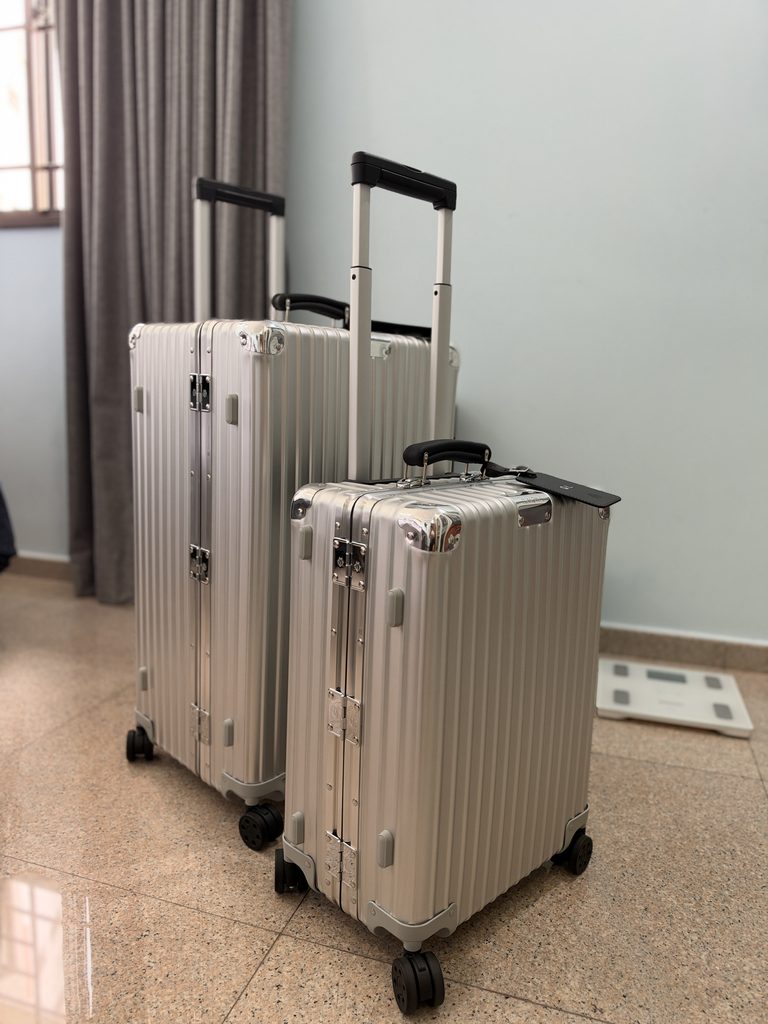
It certainly wasn’t a necessary purchase.
My previous luggage was perfectly capable of getting me from one destination to another.
But I liked the design, craftsmanship and the idea of owning something that I could use for many years.
As I gradually collect rental income from my property and receive dividend distributions from an unlisted company in which I hold shares, I have become more comfortable spending a little on myself.
Of course, there are still financial obligations to meet, and I continue to work towards my longer-term financial goals.
But I am slowly learning that financial independence shouldn’t simply be about accumulating the largest possible portfolio.
There must be room to enjoy the journey as well.
I have spent many years working, saving and investing.
Sometimes, I need to remind myself that money is ultimately a tool to support the life I want to live.
It shouldn’t become the entire purpose of that life.
7. A Short Break in Japan
Speaking of enjoying the journey, I will be heading to Fukuoka and Tokyo for a short holiday soon.
I am looking forward to taking a break from work, exploring Japan, spending some time reading in cafés and simply slowing down.
There isn’t necessarily a need to fill every day with activities.
Sometimes, having the freedom to sit in a café with a book, without worrying about the next appointment or deadline, is already something worth appreciating.
After all, isn’t that part of what financial freedom is supposed to give us?
The ability to choose how we spend our time.
8. What’s Next for My FIRE Journey?
Moving forward, I don’t foresee making significant changes to my portfolio in the immediate future.
My current intention is relatively straightforward.
I will continue accumulating exposure to SpaceX, NVIDIA and the Nasdaq-100 through QQQ, while selectively adding to other companies when opportunities arise.
As for my existing holdings, I am generally comfortable leaving them alone unless something materially changes in my investment thesis.
I also want to continue improving my understanding of the businesses I own.
There is still a long way to go before I reach the level of financial freedom I aspire to.
But looking back at the past three months, I realise that progress isn’t always reflected in a rapidly growing portfolio.
Sometimes, progress means becoming a little more knowledgeable.
Sometimes, it means being more comfortable with uncertainty.
Sometimes, it means learning to diversify rather than putting all our hopes into one company.
And sometimes, it simply means being able to enjoy a holiday, buy something we like or spend an afternoon reading without constantly worrying about money.
Perhaps the real goal of financial independence isn’t to reach a point where we never need to think about money again, but to reach a point where money no longer dominates the way we think about life.
Until the next update.
Kelvin