


The artificial intelligence industry has experienced extraordinary growth over the past few years. Companies are betting hundreds of billions of dollars in GPUs, data centres and computing infrastructure, hoping to capture the opportunities presented by increasingly capable AI models.
However, recent volatility in technology stocks, particularly among AI infrastructure and neocloud companies, has raised concerns about whether the enormous capital being invested today will eventually generate sufficient financial returns.
Against this backdrop, Anthropic is preparing for what could become one of the largest IPOs in history.
The company is reportedly looking to raise as much as US$100 billion, with discussions centred around a valuation of approximately US$1.5 trillion.
Having spent some time reading Anthropic’s S-1 filing, I find myself both impressed by its financial performance and cautious about the enormous commitments it has undertaken.
There are several observations I would like to share.
1. From OpenAI Researchers to a US$17 Billion Quarterly Business
Anthropic was founded in January 2021 by seven researchers, including Dario Amodei and his sister Daniela Amodei, both of whom previously worked at OpenAI.
Dario was formerly Vice President of Research at OpenAI and contributed to foundational research behind the development of large language models.
One of these breakthroughs involved scaling laws.
In simple terms, scaling laws describe how increasing the size of an AI model, the amount of training data and the computing power used can lead to predictable improvements in model performance.
This helps explain why Anthropic and other leading AI laboratories are investing so aggressively in computing infrastructure.
Their objective is not simply to develop a better chatbot. They are attempting to create increasingly capable AI systems that can solve complex problems, write software, conduct research and potentially perform tasks that previously required substantial human expertise.
Anthropic launched Claude commercially in March 2023.
What happened next was remarkable.
| Period | Revenue |
|---|---|
| FY2023 | US$41 million |
| FY2024 | US$386 million |
| FY2025 | US$4.59 billion |
| Q1 2026 | US$4.73 billion |
| Q2 2026 | US$11.56 billion |
| Q3 2026 | US$16.96 billion |
In just over three years since its commercial launch, Anthropic has grown from virtually no revenue to nearly US$17 billion in a single quarter.
Annualising Q3 revenue alone would imply approximately US$68 billion in annual revenue, although this is merely a calculation based on the latest quarter rather than a forecast.
To put that growth into perspective, Anthropic generated more revenue in Q3 2026 alone than it did throughout 2023, 2024 and 2025 combined.
I find this particularly impressive.
2. Anthropic’s Unusual Governance Structure
Another aspect of the filing that caught my attention was Anthropic’s founder voting structure.
The company describes its seven co-founders as stewards of its mission.
Under the proposed structure, a special Class F share held by Founder LLC, an entity initially comprising the seven co-founders, will carry 50.1% of general shareholder voting power following the IPO.
This is particularly interesting because investors such as Amazon and Google have substantial economic interests in Anthropic, yet neither will control the company through ordinary shareholder voting rights.
With the founders controlling 50.1% of general shareholder voting power, all other shareholders combined would hold the remaining 49.9%. This means that even major investors, such as Amazon and Nvidia, could not outvote the founders on matters decided through those votes. However, the Long-Term Benefit Trust’s separate authority to appoint a majority of the board means the founders’ voting control does not give them sole control over every aspect of Anthropic’s governance.
3. Is Anthropic Already Profitable?
This is probably one of the most interesting sections of the S-1.
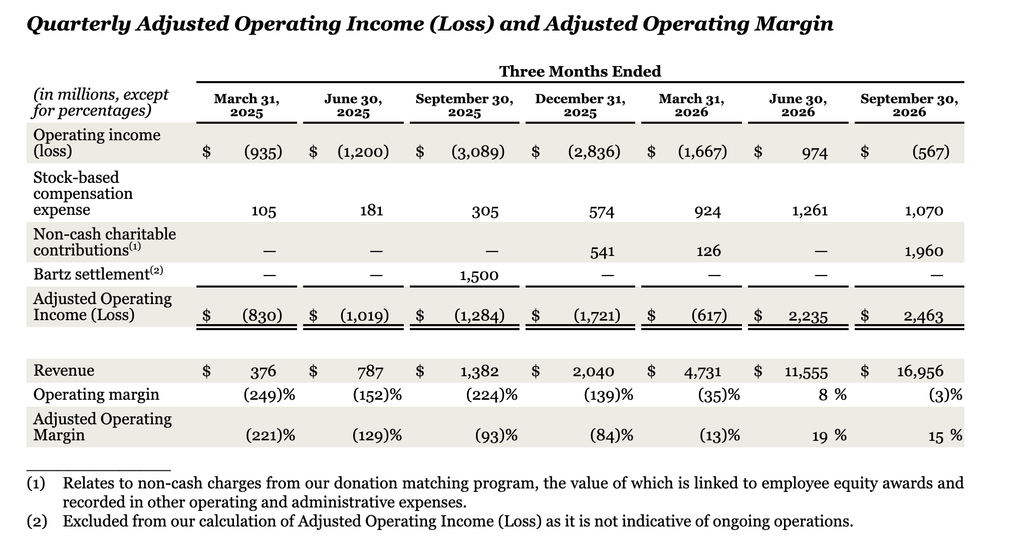
Anthropic has achieved two consecutive quarters of positive adjusted operating income.
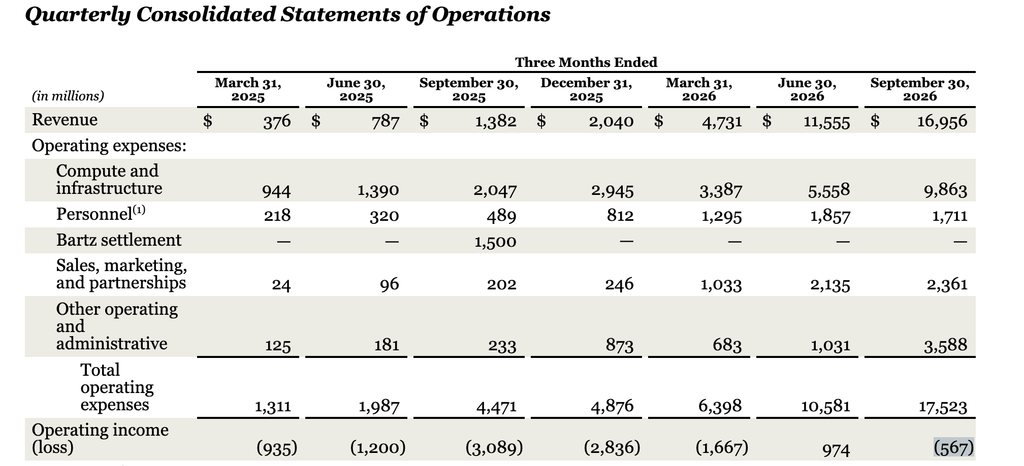
However, after examining the financial statements more carefully, I realised that adjusted operating profitability and GAAP operating profitability are not the same thing.
Here is the comparison:
| Financial measure | Q2 2026 | Q3 2026 |
|---|---|---|
| Revenue | US$11.56B | US$16.96B |
| GAAP operating income (loss) | +US$974M | −US$567M |
| Adjusted operating income | +US$2.24B | +US$2.46B |
| Adjusted operating margin | 19% | 15% |
Despite achieving positive adjusted operating income of approximately US$2.46 billion in Q3, Anthropic actually reported a GAAP operating loss of US$567 million.
How did it reconcile these figures?
The company excluded approximately US$1.07 billion in stock-based compensation and US$1.96 billion in non-cash charitable contributions linked to its employee donation-matching programme.
Anthropic’s adjusted operating profit excludes stock-based compensation and certain other expenses. Including these expenses, the company still reported an operating loss.
Despite revenue rising approximately 47% quarter-on-quarter, compute and infrastructure expenses increased by approximately 77%, partly due to expensive short-term computing arrangements. This pushed adjusted operating margin down from 19% to 15%.
Over the next few quarters, I will be watching whether revenue can grow faster than costs, allowing Anthropic to achieve operating leverage and sustained operating profitability.
4. Can Anthropic Generate Enough Revenue to Support Its Computing Costs?
One important reason Anthropic’s revenue has grown so rapidly is its consumption-based pricing model.
Unlike a traditional software business that relies primarily on fixed monthly subscriptions, Anthropic earns a substantial majority of its revenue from customers paying for AI usage.
The S-1 disclosed that approximately 79% of its revenue during the first nine months of 2026 was consumption-based.
This means that as customers increasingly use Claude for coding, research, enterprise workflows and other complex tasks, they can generate additional revenue for Anthropic.
Products such as Claude Code may be particularly important because sophisticated agentic workflows can involve numerous model calls and substantial token consumption.
Anthropic can also charge different prices for different model capabilities, allowing customers to select between cost-efficient and more powerful models.
However, the important question is whether this additional revenue grows faster than the computing costs required to deliver it.
I find the improvement in Anthropic’s revenue relative to computing expenses particularly interesting.
In FY2025, Anthropic generated approximately US$0.63 in revenue for every US$1 of compute and infrastructure expense.
By Q3 2026, that figure had improved to approximately US$1.72.
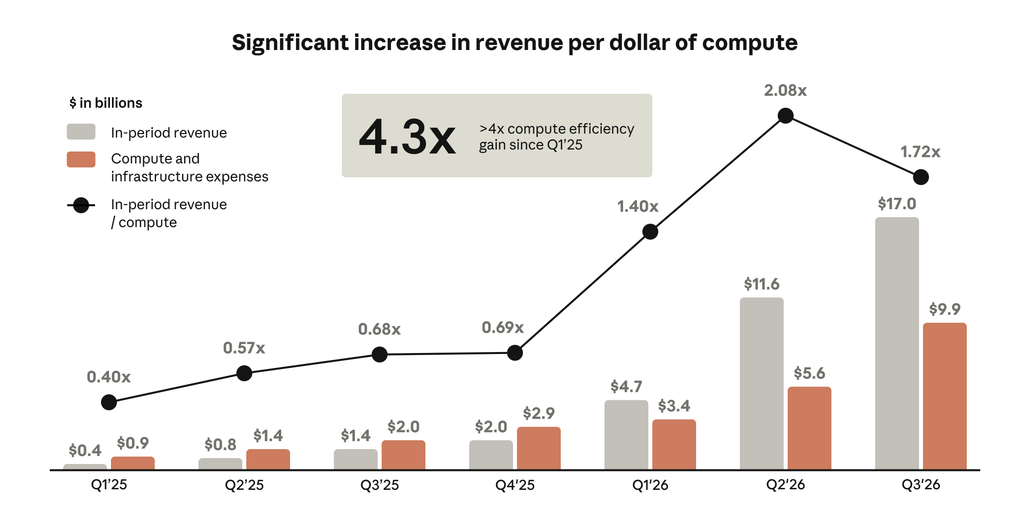
This is a meaningful improvement.
However, this ratio includes total company revenue and computing expenditure associated with research, training, inference and internal usage. It is not equivalent to gross margin or profit on individual customer requests.
There are also risks.
As AI becomes more competitive, companies may be forced to reduce prices. Open-weight models could become increasingly capable, while improvements in chip efficiency and model architecture may lower the cost of supplying AI services.
Lower costs are beneficial, but competition may also pass those savings on to customers.
Ultimately, Anthropic’s success depends not only on developing smarter models, but also on capturing enough economic value from those models to justify the resources invested in developing and operating them.
5. The US$895 Billion Question
This brings me to perhaps the most important financial risk in Anthropic’s S-1.
As of and subsequent to 30 September 2026, Anthropic disclosed approximately US$895.4 billion in aggregate computing and infrastructure purchase commitments and lease agreements.
That is an extraordinary amount of money.
However, it is important to distinguish these commitments from actual expenditure already incurred.
The US$895.4 billion extends across multiple years, with approximately US$447.5 billion expected to be incurred before the end of 2030.
Substantially all the remainder is expected to be incurred between 2031 and 2045.
Approximately US$69.8 billion is due during the 12 months following 30 September 2026.
Some commitments are also conditional or subject to termination rights. Therefore, the headline figure should not be interpreted as an entirely unavoidable bill payable immediately.
Nevertheless, it illustrates the enormous capital requirements involved in remaining competitive at the frontier of AI development.
Anthropic’s Major Computing Partners
Anthropic has established agreements with several major hyperscalers and infrastructure providers.
Some of the disclosed arrangements include:
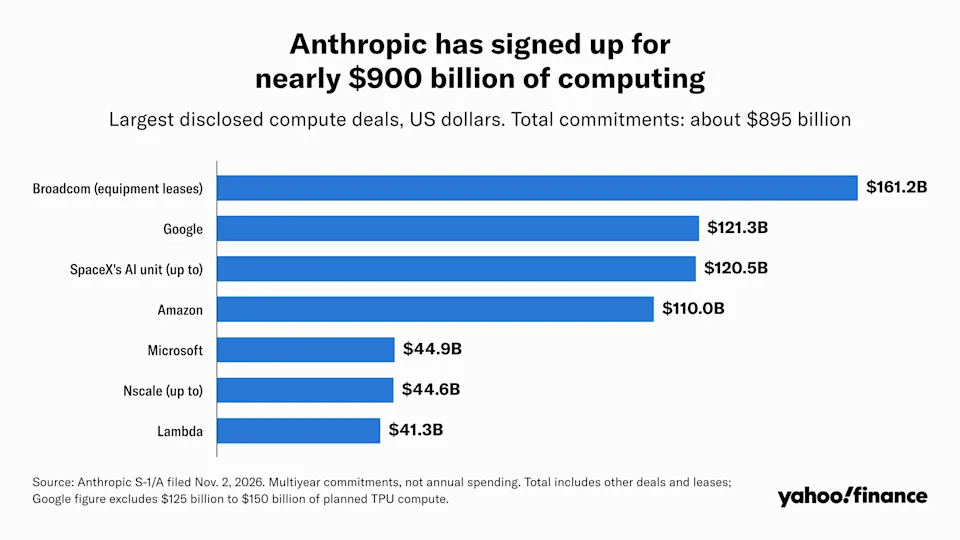
These agreements differ in duration and contractual conditions. Some represent minimum purchases, while others are potential maximum values or equipment leases, and they should not simply be added together as identical obligations.
Anthropic also has other infrastructure arrangements beyond this list.
What I find particularly interesting is its decision to diversify computing across different providers and chip architectures.
Rather than relying exclusively on NVIDIA GPUs, Anthropic can also use Google’s TPUs, Amazon’s Trainium accelerators and AMD GPUs.
This potentially reduces dependency on any single supplier and provides greater flexibility in allocating workloads according to cost and performance.
I believe this is strategically sensible.
However, diversification does not eliminate financial risk.
Some of these contracts require significant minimum payments, regardless of actual computing usage.
The company has also begun investing more directly in infrastructure through its Anthropic Direct initiative, which involves leasing computing hardware and operating it in dedicated facilities managed on its behalf.
While this could improve long-term economics, it also introduces additional financing and capital expenditure requirements.
In my view, the real issue is not whether AI demand will continue growing.
Rather, it is whether Anthropic’s revenue can grow sufficiently to support these enormous obligations without putting excessive pressure on its balance sheet.
6. Strategic Investors and the Interconnected AI Ecosystem
Another aspect of Anthropic’s business model I find fascinating is its relationship with its strategic partners.
Amazon and Google are both important investors in Anthropic and also provide substantial computing infrastructure.
According to the S-1, both will hold more than 5% of Anthropic’s outstanding capital stock following certain conversions, primarily through non-voting shares.
This creates a potentially beneficial relationship.
Amazon provides financing and computing capacity to Anthropic, while Anthropic purchases AWS services to train and deploy its models.
As Anthropic grows, Amazon could benefit from increased cloud revenue as well as appreciation in its investment.
However, their interests are not perfectly aligned.
Amazon is still operating a commercial cloud business, and Anthropic must negotiate computing costs that allow it to remain financially sustainable.
There is another aspect worth considering.
Across the AI industry, hyperscalers, AI laboratories, chipmakers and neocloud providers are increasingly interconnected through investments, financing agreements and computing contracts.
These relationships can accelerate infrastructure development, but they also raise questions about concentration risk and the ultimate source of demand.
Are AI companies generating sufficient revenue from independent paying customers, or is a significant portion of the ecosystem’s growth being sustained by continuing capital investment among industry participants?
I believe the distinction matters.
The long-term sustainability of this industry ultimately depends on businesses and consumers finding sufficient economic value in AI services to support the costs of the entire infrastructure supply chain.
7. Why Is Anthropic Pursuing an IPO Despite Having So Much Cash?
One of the most surprising things I discovered in the filing was Anthropic’s substantial liquidity.
As of 30 September 2026, the company reported:
| Financial resources | Amount |
|---|---|
| Cash and cash equivalents | US$95.6B |
| Short-term investments | US$36.3B |
| Available credit facility | US$14.8B |
| Total liquidity | US$146.6B |
It is worth noting that the US$146.6 billion includes undrawn borrowing capacity and is therefore not entirely cash on hand.
Anthropic also disclosed that it had raised approximately US$141.1 billion in cumulative capital by the end of September 2026.
With such substantial financial resources and positive operating cash flow, why would Anthropic need to pursue an IPO?
I believe the answer lies in the scale of its future ambitions and financing commitments.
While the company has considerable liquidity today, its future infrastructure obligations are significantly larger.
Moreover, AI computing infrastructure often needs to be secured well before it becomes available for commercial use.
This creates a mismatch between the timing of investment and the revenue expected to be generated from that investment.
Anthropic may therefore need to continue raising capital even as its underlying business becomes more profitable.
Why Not Simply Issue More Debt?
Debt avoids diluting existing shareholders, but it comes at a price.
With the US 10-year Treasury yield already close to 5%, lenders would generally demand an additional return to take on corporate credit risk. For Anthropic, the question is how much that premium would be, given its short operating history and enormous future computing commitments.
Elon Musk recently warned that debt markets had become increasingly difficult to access for companies heavily dependent on AI data-centre revenue. Although his comments focused on neocloud providers, they highlight growing concerns about financing the AI infrastructure boom.
In my view, this helps explain the appeal of an IPO. Issuing equity dilutes shareholders, but it also provides capital without adding contractual interest payments and principal repayments. Anthropic can still access debt; the question is whether borrowing substantially more would be attractive at the price lenders demand.
8. Can Anthropic Achieve a US$1.5 Trillion Valuation?
This is where I become somewhat cautious.
Following the Democrats’ victory in both the House and Senate in the November 2026 midterm elections, the political outlook for AI has become more uncertain. They are due to take control of Congress in January. Congresswoman Yassamin Ansari has called for a pause in advanced AI development and a ban on artificial superintelligence, although these calls do not amount to an enacted nationwide pause.
Personally, I do not expect AI training or data-centre development to stop over the long run. I believe the industry will continue expanding, although potentially at a slower pace and under tighter regulation.
But an IPO also depends on the mood of the market at the time. Investors may believe in AI’s long-term potential while still being reluctant to commit substantial capital at the price being asked, especially when political uncertainty is making them more cautious about the returns from AI investment.
For Anthropic, a US$1.5 trillion valuation would depend heavily on expectations of future growth and profitability. Investors will need to assess whether the company can sustain its revenue growth and achieve sustained operating profitability despite its high computing costs. Political uncertainty adds another complication to that assessment.
Despite these concerns, I do not expect Anthropic to put its IPO on hold for long. Although it has substantial liquidity today, its enormous computing commitments create pressure to secure funding well ahead of future payments. In my view, waiting for a more favourable market could leave the company with less financial flexibility as those commitments come due. That gives it a strong incentive to proceed, even if investor appetite falls short of its fundraising ambitions.
That said, a lower valuation would not necessarily prevent Anthropic from raising US$100 billion. The relationship is straightforward:
Gross money raised by the company = offer price per share × number of new shares sold.
| Post-IPO valuation | Money raised | Ownership sold to new investors |
| US$1.5 trillion | US$100 billion | 6.7% |
| US$1.2 trillion | US$100 billion | 8.3% |
| US$1 trillion | US$100 billion | 10% |
If Anthropic accepts a lower offer price, it could sell more new shares to reach the same fundraising target, provided there is sufficient investor demand. The trade-off would be greater dilution for existing shareholders. For example, raising US$100 billion at a US$1 trillion post-IPO equity valuation would mean selling 10% of the company, compared with approximately 6.7% at US$1.5 trillion, assuming all proceeds come from newly issued shares and before fees.
In my view, its substantial funding needs create a strong incentive to prioritise raising capital, even if that means accepting a lower valuation. However, that does not mean it must raise exactly US$100 billion at any price.
The IPO may also be only one stage of its financing journey. Anthropic’s S-1 says it expects to fund long-term requirements through operating cash flows, equity and debt financing, and arrangements with its partners.
Using its September figures, US$95.6 billion in cash and cash equivalents plus a hypothetical US$100 billion raise would total about US$195.6 billion before fees and subsequent spending. Including US$36.3 billion in short-term investments would bring that to US$231.9 billion. Its US$895.4 billion in commitments extend over many years, substantially through 2045, so the difference is not an immediate cash shortfall or an amount that must all be raised externally. Future operating cash flow can help fund those payments.
I therefore expect further financing in the years ahead. Stronger earnings, better cash generation or improved credit-market conditions could make debt more attractive. Alternatively, Anthropic could issue more shares, bringing further dilution. The mix will depend on its financial performance and the terms available at the time.
For me, this means the IPO is unlikely to be the only opportunity to consider investing. I expect opportunities to reassess the company after listing as its financials and funding needs become clearer, although there is no guarantee that future share prices will be lower.
9. Final Thoughts: The Difference Between Technological Success and Investment Returns
After reading Anthropic’s S-1, my impression of the company is generally positive from a business perspective.
It has demonstrated extraordinary revenue growth in a relatively short period, developed highly capable AI models, expanded enterprise adoption and improved the revenue generated relative to its computing expenditure.
Its diversified infrastructure strategy and relationships with major technology companies could also provide important competitive advantages.
Furthermore, its financial statements suggest that the underlying business is becoming significantly more economical, despite the enormous headline net losses caused partly by accounting adjustments.
However, I remain cautious about the sheer scale of its long-term computing commitments.
With nearly US$900 billion in aggregate infrastructure obligations extending over many years, Anthropic is making a substantial bet on the continued growth and monetisation of artificial intelligence.
I do not doubt that AI will become increasingly important across many industries.
But I believe investors must distinguish between the potential of a technology and the ability of individual companies to generate attractive financial returns from it.
The key questions I will continue monitoring are whether Anthropic can sustain its revenue growth, improve operating margins, generate sufficient free cash flow and avoid excessive shareholder dilution as its infrastructure spending expands.
Ultimately, what makes a great technology company is not simply its ability to develop groundbreaking products.
It is also its ability to allocate capital efficiently and convert technological innovation into sustainable economic value.
AI may well transform the world. But the companies that transform the world are not necessarily the same companies that deliver the best returns to shareholders.
And that, to me, is what makes Anthropic’s upcoming IPO so interesting.
Disclaimer: This article reflects my personal observations and interpretation of publicly available information as of 7 November 2026. It is not intended as investment advice. All valuations, financial estimates and future expectations are subject to change.